Our Location
304 North Cardinal St.
Dorchester Center, MA 02124

304 North Cardinal St.
Dorchester Center, MA 02124

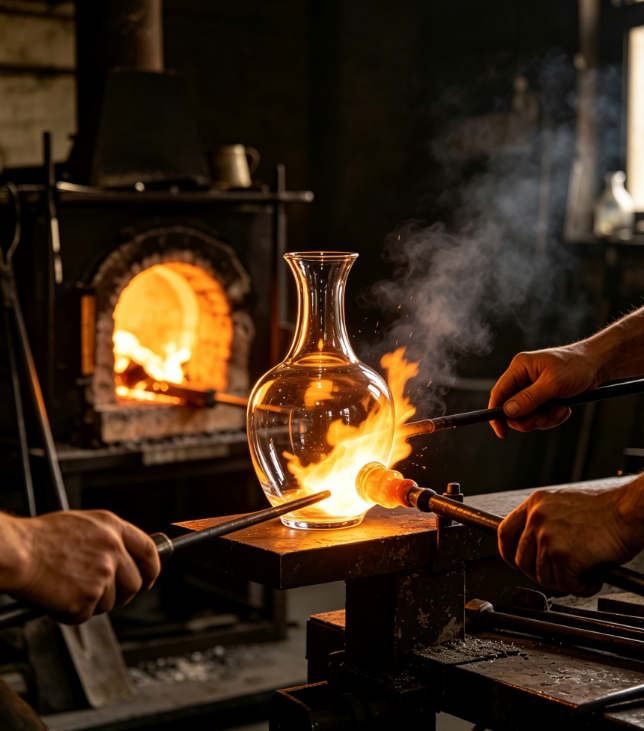
Have you ever wondered what a glass vase goes through before it arrives in your home?
It’s not just “clicked” out of a machine. At Orimart, every handcrafted glass vase is born from a dialogue with fire — shaped, cooled, and formed at over a thousand degrees, until it becomes that one-of-a-kind object in your space.
Step 1: Batching and Melting
The starting point of glass is a pile of unremarkable raw materials — silica sand, soda ash, limestone, and feldspar. These ingredients are crushed, dried, and purified, then fed into a furnace and melted at temperatures around 1150°C until they transform into a syrup-like molten glass. It’s like turning stone into honey.
Step 2: Gathering and Blowing
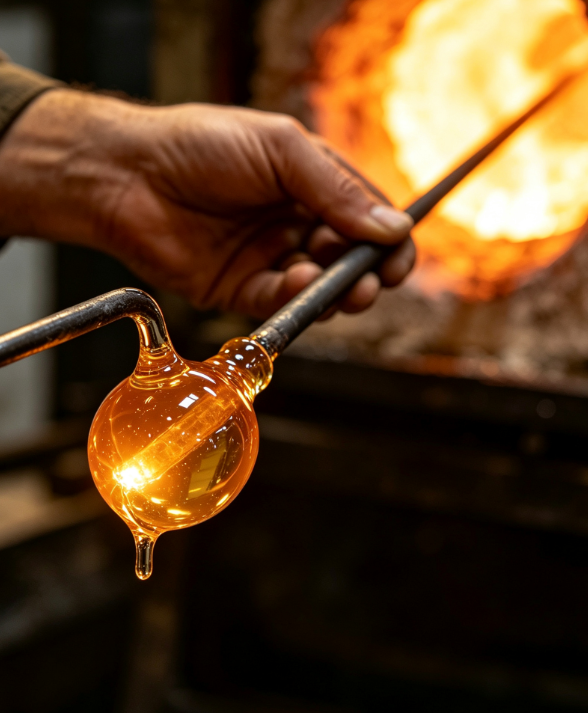
The essential tool for handmade glassblowing is a hollow iron pipe, about 1.5 meters long. The craftsman dips one end into the furnace to gather a glowing lump of molten glass — this is called “gathering”. The weight of the gather is entirely in the hands; too much or too little will affect the final form.
Then, the craftsman blows into the other end of the pipe. The glass expands under the pressure, forming a hollow bubble. This step looks simple, but it demands exceptional skill — too much air and the walls become too thin; too little and the shape won’t open properly. Controlling the breath is a craft in itself, born from years of experience.
Step 3: Shaping and Reheating
Glass cools quickly. The craftsman must constantly return the semi-finished piece to a secondary furnace called the “glory hole” to keep it pliable throughout the process.
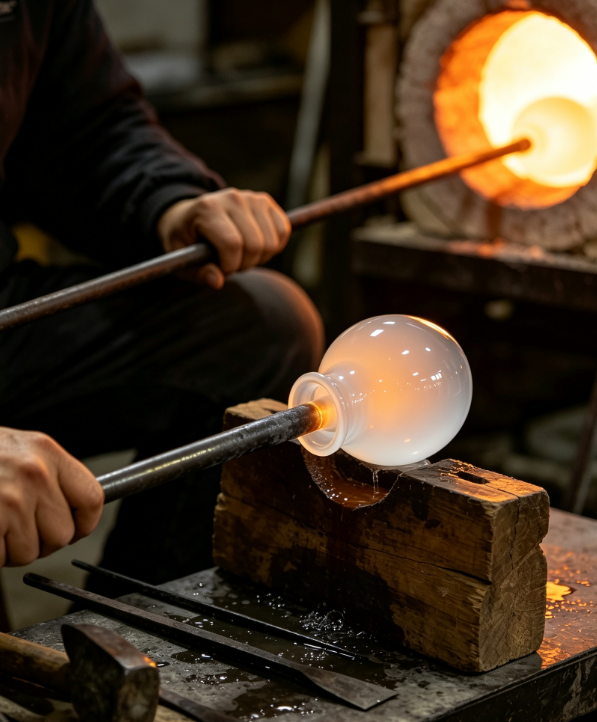
After each reheating, the craftsman continues blowing, rotating the pipe, and using various tools — wet newspapers, wooden molds, tweezers, and more — to shape the glass. The speed of rotation determines whether the wall thickness is even. Too fast or too slow, and the final piece will have uneven spots.
This cycle may be repeated a dozen times or more, until the silhouette of the vase gradually emerges in the craftsman’s hands. It is blown, and also sculpted.
Step 4: Opening the Rim and Finishing the Base
Once the body is roughly formed, the craftsman needs to finish the rim and the base. Special tongs are used to open the rim and refine the edge while the glass is still hot. Another solid iron rod (the punty) is attached to the bottom of the vase. The piece is then tapped off the blowpipe, and the base is carefully finished so it can stand firmly on a table.
Every step demands precise control of temperature, force, and timing.
Step 5: Annealing – The Longest Wait
Think it’s done once it’s blown? Not yet.
Freshly formed glass is filled with internal stress. If cooled directly, it would crack on its own without warning. It must be placed into a lehr (annealing oven) and cooled gradually over 12 to 24 hours, or even longer, under strictly controlled temperatures. This process is called annealing. It allows the stresses inside the glass to slowly release, making the vase truly durable and strong.
Step 6: Cold Working (Optional)
After annealing, if the vase needs additional decoration — such as engraving, gilding, or carved patterns — it enters the cold-working stage. Craftsmen use grinding wheels to carve lines, curves, or fine floral and bird motifs onto the glass surface, turning a plain glass vessel into a true work of art.
A handmade glass vase travels from a pile of powder to your table through at least a dozen processes, dozens of heating and cooling cycles, and countless hand adjustments. It is not a copy off an assembly line. It is a piece that a craftsman has nurtured through breath, touch, experience, and patience — working in front of heat exceeding a thousand degrees.
Every handmade glass vase carries the craftsman’s presence and warmth. That is why each truly handcrafted piece is unique — the bubbles, the subtle variations, the slight imperfections are not flaws; they are the marks of being shaped by human hands.
At Orimart, we believe a good vase is more than a flower holder. It is a sculpture in your space, a play of light and shadow, something you will glance at and admire every day. If you are looking to add such a piece to your home — you are welcome to see what we are making.
