Our Location
110, No. 2, Baoyi Industrial Zone
Nanshan District, Shenzhen
110, No. 2, Baoyi Industrial Zone
Nanshan District, Shenzhen
How lenticular posters are actually made: LPI and sheet thickness trade-offs, flip versus 3D versus animation effects, artwork rules that survive interlacing, MOQ and lead times, six QC checks for the PO, and packing that prevents warping.
A lenticular poster looks like magic on a shelf and looks like a headache on a purchase order. The customer sees a newspaper that rewrites itself when they tilt their head. The buyer sees a plastic sheet, an interlaced print, an alignment tolerance and a carton that has to survive a subtropical container in July.
This guide is written for the second person. It covers what a lenticular poster actually is, which effect format suits which product, the sheet specifications that move your unit cost, what artwork files get rejected, and the six quality checks worth writing into the PO before you release a balance.
Quick answer
The word gets used loosely in product listings, so it is worth being precise with a supplier. A lenticular print has two physical layers:
Because each lens only lets the eye see the strip group directly beneath it, and the eye position changes with viewing angle, tilting the print walks the viewer through the frames. That is the entire mechanism. Nothing is holographic, nothing is electronic, and nothing needs a battery — which is exactly why the format sells in gift retail.
The manufacturing consequence is unforgiving: the interlace pitch must match the sheet LPI, and the print must stay in registration across the whole sheet. A shift of a fraction of a millimetre at one edge shows up as ghosting — two frames visible at once — and the piece is unsellable.
Buyers usually fall in love with a reference video, then discover the effect needs a frame count or a sheet that does not fit the target retail price. Work backwards from the effect.
| Effect | Frames | Typical LPI | What it suits | Main risk |
|---|---|---|---|---|
| Flip / change | 2–3 | 40–60 | Licensed art, gift retail, novelty packaging | Ghosting if registration drifts; weak concept if the two frames are too similar |
| 3D / depth | 2–4 layers | 60–75 | Portraits, packaging mockups, product hero shots | Flat artwork reads as cardboard cut-outs with no depth separation |
| Animation / morph | 6–12+ | 75–100 | Small promo items, bookmarks, character sequences | Narrow viewing angle and heavy file sizes; poor value at poster size |
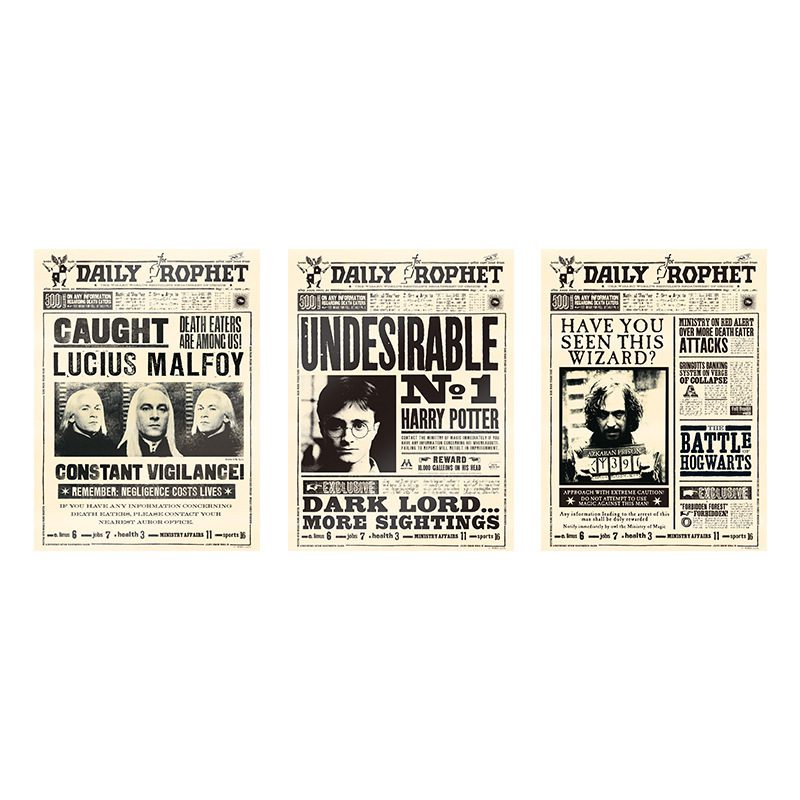
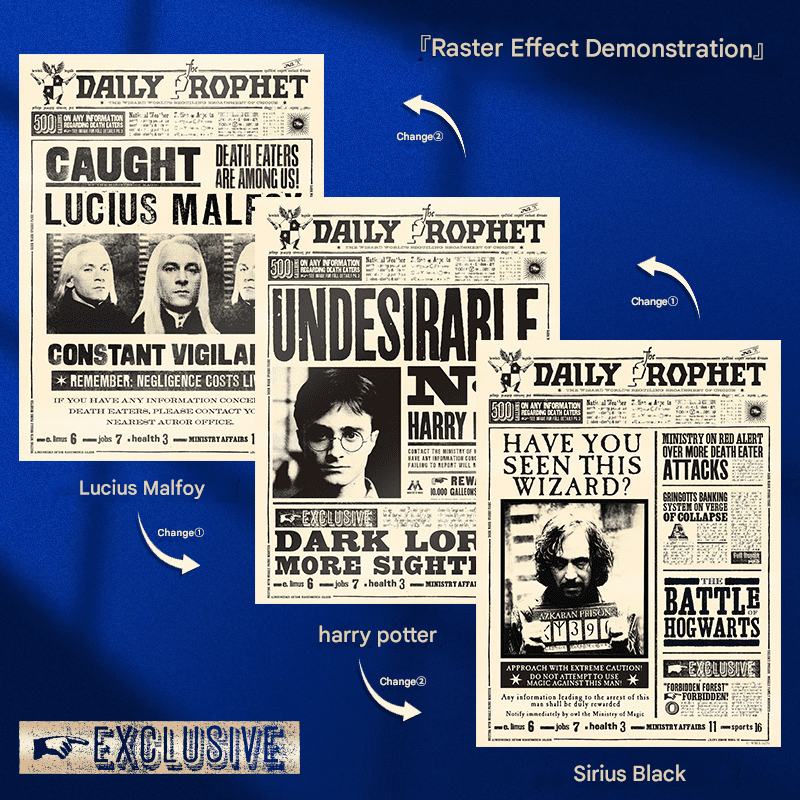
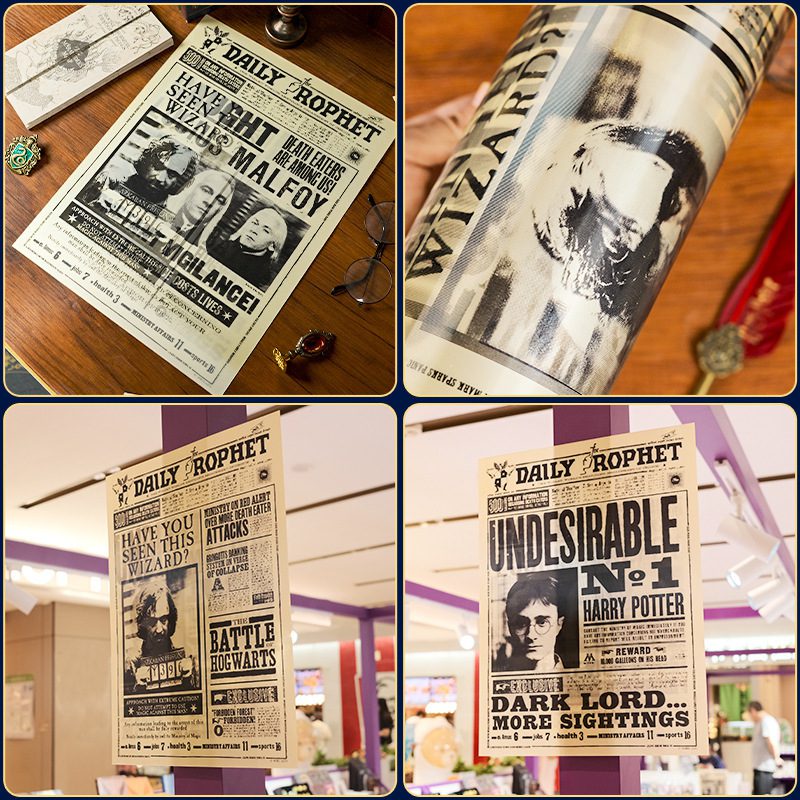
For wall art at 30×40 cm — the size most gift and decor buyers settle on — a two to three image flip is the sweet spot. It reads instantly from a metre away, needs only two or three artwork frames, and keeps the sheet thin enough to retail at a gift price. That is the specification behind our moving Daily Prophet lenticular poster, which flips between three frames on 0.6 mm PET at 30×40 cm.
Four variables drive unit cost. Ask for them in this order, because each one constrains the next.
| Variable | Options | Buying guidance |
|---|---|---|
| Material | PET, PP | PET is stiffer, flatter and more scratch-resistant, and holds registration better on large sheets. PP is cheaper and softer but cups more readily. For retail wall art, specify PET. |
| Thickness | 0.45 / 0.6 / 0.9 mm | 0.6 mm is the retail default. 0.9 mm is worth the upgrade for humid destinations, unframed hanging and anything above A2. Thinner sheets ship cheaper but sag in a frame. |
| LPI | 40 / 50 / 60 / 75 / 100 | Lower LPI gives a wider viewing angle and softer detail, and is forgiving on big sheets. Higher LPI gives finer detail and more frames, but the sweet spot shrinks — the viewer has to stand almost straight on. |
| Surface | Standard, anti-scratch hard coat, matte | Add a hard coat on anything that will be handled in store or shipped without a protective sleeve. It is the cheapest insurance against the most common return reason. |
One practical note on thickness: lenticular sheet is sold by area and weight, so a jump from 0.6 mm to 0.9 mm raises the material component of your unit cost proportionally to the extra grammage. Ask the factory to quote both so you can see the actual delta rather than a percentage guess.
Interlacing is not a filter you can run on a flat JPEG and hope for the best. Send frames, not a flattened file.
Vector logos and solid brand colour blocks are the safest elements. Fine serif body text under about 8 pt tends to break up behind the lenses — keep small type off the print, or set it larger.
There are two production routes and they behave differently at different volumes.
Ask which route your quote assumes. A quote that silently switches from UV to lamination between sample and bulk is a common reason sample colours do not match production.
Lenticular has a higher tooling floor than flat print because the lens sheet is bought in standard widths and cut down. That shapes the commercial terms.
| Stage | What happens | Realistic timing |
|---|---|---|
| Interlace proof | Frames interlaced to the target LPI and reviewed as a digital simulation | 2–4 days |
| Physical sample | Printed and laminated on the actual sheet, cut to size, shipped by courier | 7–15 days plus transit |
| Bulk production | Print, laminate or coat, cut, inspect, pack | 20–35 days after sample approval |
| Carton packing | Sleeving, corner protection, flat stacking, master carton | 2–4 days |
Many custom decor items on our line start at 50 pcs, and mixed containers are available if you want to test lenticular alongside other categories. The exact MOQ for a given size and effect is confirmed on the quote, because sheet width utilisation changes with the trimmed size.
Inspection language is what separates a supplier relationship from a gamble. These are the six that catch real problems:
Lenticular sheet behaves like a thin rigid panel with a soft plastic memory. Two rules cover most damage:
Inside the carton, a PE sleeve plus two rigid boards per bundle, corner protection, and flat stacking with no bridging load is the specification that arrives intact. Adding a cardboard easel or a hang tab is a cheap retail upgrade worth discussing with your buyer at sample stage rather than after the PO is confirmed.
Three questions come up on nearly every lenticular enquiry, and it is worth asking them before the artwork is final:
Many items start at 50 pcs, and mixed containers are available. Exact MOQ depends on the trimmed size, the sheet width utilisation and the number of designs, and is confirmed on your quote.
Two to three frames is standard for a flip poster at wall-art size. Animation effects can carry six to twelve frames or more, but they need a finer sheet and a narrower viewing angle, so they work better on small items.
PET for retail wall art. It is stiffer, flatter, holds registration better and resists scratching. PP is cheaper and softer but cups more readily, especially in hot or humid shipping conditions.
Send separate frames at full resolution with identical crop and registration, and we handle the interlacing to the target LPI. Digital simulation comes first, then a physical sample for approval. Layered files or vector art are easiest.
Interlace proof in a few days, physical sample in roughly 7 to 15 days plus courier transit, and bulk production 20 to 35 days after sample approval. Packing adds a few more days.
Specify PET sheet, add an anti-scratch hard coat, ship flat rather than rolled, and pack with rigid boards and corner protection. For hot destinations, choose 0.9 mm to hold flatness.
Send your artwork frames, target size and destination market. We reply with price, MOQ and lead time — typically within one business day.
Related reading: see the finished moving Daily Prophet lenticular poster for a real 3-frame specification, browse our OEM case studies for sketch-to-sample projects, or read factory facts for how our production and QC are set up. Buying other decor categories? Start with the B2B sourcing guide.
